Research Themes in the Tomiya Group
Tomiya's Research Area for a General Audience
My research is centered on theoretical particle physics, combining numerical computation, machine learning, and high-performance computing. Protons and neutrons are made of quarks and gluons. The theory that describes them is quantum chromodynamics (QCD), and one of the main computational approaches to studying QCD is lattice QCD.
In lattice QCD, spacetime is discretized into a lattice, and the dynamics of quarks and gluons are simulated on computers. This makes it possible to study the inside of atomic nuclei and the behavior of matter under extreme conditions, such as the early universe, where direct experimental access is difficult.
Recently, machine learning has become an important tool for such large-scale simulations. It can be used not only to classify data, but also to detect phase transitions and improve the efficiency of simulations. Through lattice QCD, machine learning, and research software such as JuliaQCD, my group develops new computational methods for difficult problems in particle physics.
I am also interested in new computational technologies such as automatic differentiation and quantum computation. Automatic differentiation helps computers efficiently track how complicated calculations change, which is useful in both machine learning and physics simulations. Quantum computation may eventually provide new ways to study quantum field theory and gauge theory.
Tomiya's Research Themes for Undergraduate Students
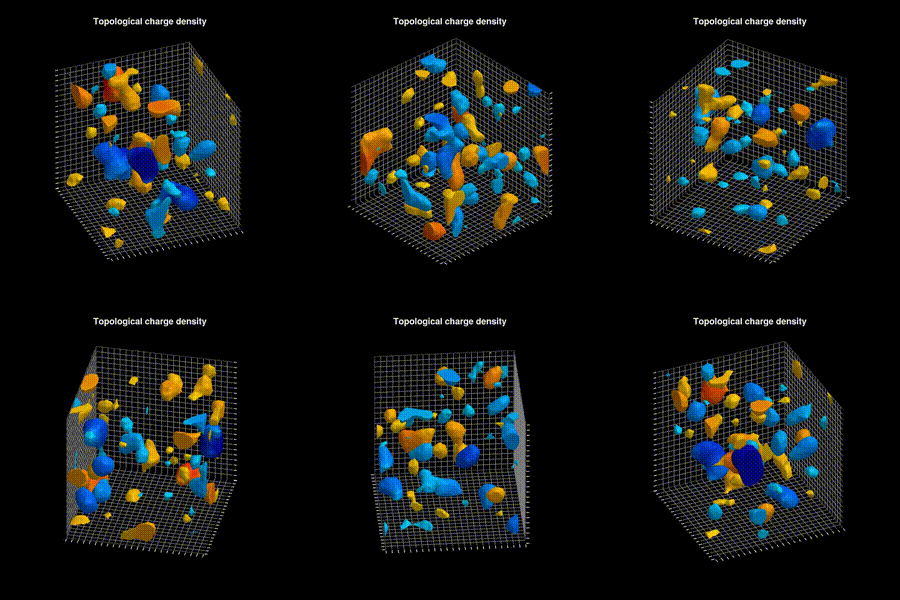
More technically, I work on non-perturbative particle physics using lattice gauge theory, especially lattice QCD. QCD describes the interactions of quarks and gluons, but at low energies the coupling is strong and ordinary perturbative methods are not sufficient. By discretizing spacetime and generating field configurations with Monte Carlo methods, one can study hadron properties, finite-temperature QCD, chiral symmetry, axial U(1) symmetry, and topology.
Lattice QCD calculations are computationally expensive, so my group also studies machine-learning methods for improving computational algorithms. Examples include self-learning Monte Carlo, gauge-covariant neural networks, equivariant transformers, and normalizing-flow methods for lattice gauge theory. Designing neural networks that preserve the symmetries of the physical system is one of the central themes.
Another recent direction is the use of automatic differentiation in lattice gauge theory. Automatic differentiation makes it possible to compute derivatives of actions and observables accurately and systematically. This is useful for gradient-based optimization, improved sampling, and coupling machine-learning models to lattice field theory. Using automatic differentiation safely and efficiently in systems with many degrees of freedom and strong symmetry constraints is an important research problem.
I also develop research software centered on JuliaQCD. Using Julia, Python, and C++ as needed, my group builds code that can be used from laptop-scale prototyping to large-scale supercomputer simulations. A central feature of the group is the combination of physics, mathematics, information science, and programming to apply new algorithms to concrete problems in particle physics.
For Prospective Students
Students interested in machine learning, numerical computation, theoretical particle physics, and supercomputing are welcome. In choosing research topics, I start from what students want to do and try to accept projects as much as possible when they are within the range I can responsibly cover. Topics may cross mathematics, information science, and physics.
Past undergraduate thesis topics include representations of groups (2024), speech recognition, image recognition, weather prediction, and programming-language implementation (2025).
Related resources include books, teaching records, book list on note, and a YouTube playlist.
Research Papers
For a full list of research papers, please see INSPIRE-HEP.