
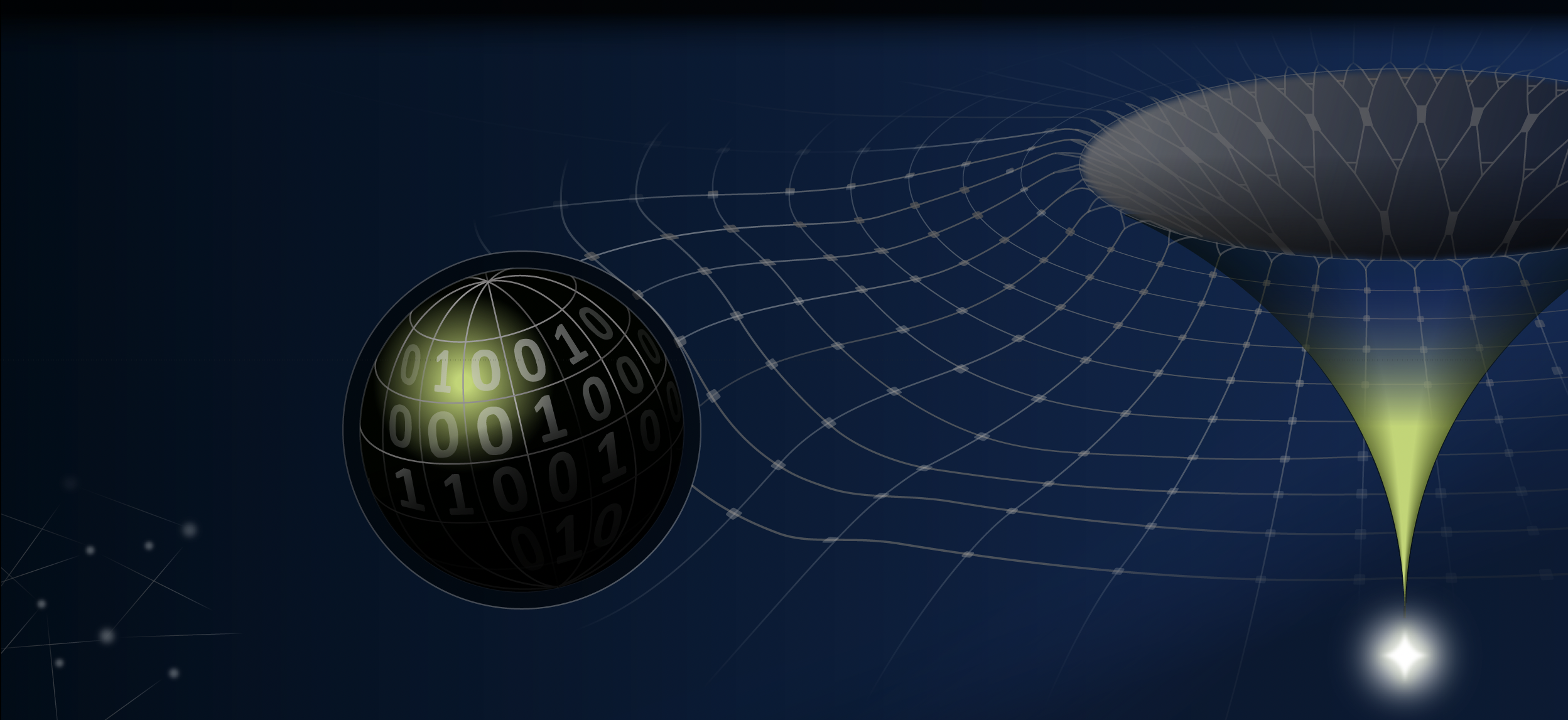
We aim to elucidate the "extreme universe" from the new perspective that all things are composed of "quantum information", going beyond the conventional understanding of "time, space, and matter" in physics. This "extreme universe" refers to the extreme conditions of the natural world, and includes the following three targets:
(i) quantum theory of Black holes (i.e. the limit of space),
(ii) quantum theory of Cosmology (i.e. the limit of time),
(iii) Dynamics of quantum matter (i.e. the limit of matter).
To solve these problems, we need the ultimate understanding of the laws of physics.
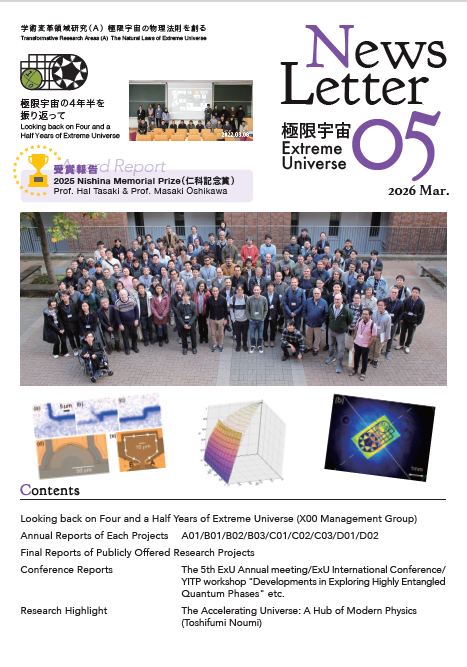
News Letter 05(Mar.2026)
We have opened [a Youtube channel] dedicated to our collaboration activities. The videos we have now include the videos of the colloquia. We expect that more videos will come up in the near future.
WHAT’S NEW
We are pleased to announce that Prof. Kotaro Tamaoka (Nihon University), Principal Investigator of the Publicly Offered Research Group E02, and Prof. Takanori Anegawa (National Institute of Technology, Yonago College), Research Collaborator of the Planned Research Group B01, have received "the 21st Particle Physics Medal: Young Scientist Award in Theoretical Particle Physics." Congratulations!
For further details, please see the following links: [Nihon University] [YITP, Kyoto University].
The FY2025 achievements of the Extreme Universe Research Area are now available. A list of research achievements and press releases, including those from previous fiscal years, can be found at: [Achievements and Outreach].
We will have the 11th public ExU Online Colloquium “Public ExU Colloquium” on May 11 (Mon.) 10:00 (JST). The speaker is Dr. Miles Stoudenmire (Center for Computational Quantum Physics, Flatiron Institute). For details, please refer to the poster. If you have not registered yet, please register at our online event website at least three days prior to the colloquium. (It is not necessary to register again if you have done it already.)
The Principal Investigators of Publicly Offered Research Project, Hiroyasu Tajima (Kyushu University) and Takashi Takagi (University of Tokyo) have received the FY2026 MEXT Young Scientists Award. Congratulations. For details, please see [Link].
The Grant-in-Aid for Transformative Research Areas (A) “Extreme Universe” officially concludes today. We sincerely thank you for your tremendous support over the years. Thanks to your contributions, our members have produced numerous research achievements and successfully opened up new scientific frontiers. We will continue to share related updates through this account for approximately the next six months.